Nyan Corridor :

Social Research and Knowledge for a Just Society

RESEARCH

Nyan Corridor conducts interdisciplinary research spanning political economy, governance, climate change, humanitarian governance, legislative studies, and everyday life under conflict. Drawing on community-based ethnographic methods and collaboration with international partners, the organization examines how communities across Myanmar and the Indo–Myanmar borderlands experience armed conflict, military rule, capitalist transformation, and climate stress. Through locally grounded, rigorous inquiry, Nyan Corridor aims to amplify community voices and inform more inclusive governance, humanitarian action, and evidence-based policymaking.

The School of Social Research of Nyan Corridor is a scholar-activist initiative dedicated to producing critically grounded knowledge that challenges unequal global circuits of knowledge and power. Anchored in Critical Political Economy and Political Ecology, the School advances collaborative research and pedagogy to interrogate capitalist, authoritarian, and extractive structures shaping Myanmar and the wider world in pursuit of a just society.”

SCHOOL OF SOCIAL RESEARCH

The School of Social Research of Nyan Corridor is a scholar-activist initiative dedicated to producing critically grounded knowledge that challenges unequal global circuits of knowledge and power. Anchored in Critical Political Economy and Political Ecology, the School advances collaborative research and pedagogy to interrogate capitalist, authoritarian, and extractive structures shaping Myanmar and the wider world in pursuit of a just society.”

Humanitarian Observatory Myanmar (HOM) is a community-rooted initiative working to transform how humanitarian governance in Myanmar is understood, practiced, and held accountable. Rooted in local realities and connected to global research networks, HOM documents lived experiences, analyzes how humanitarian systems function on the ground, and brings frontline voices into national and international decision-making spaces. Through evidence-based research, community-led analysis, and advocacy, HOM challenges top-down approaches to aid and promotes more inclusive, responsive, and accountable humanitarian action. 

COMMUNITY RESEARCH : RESEARCHERS AND RESEARCH AREAS

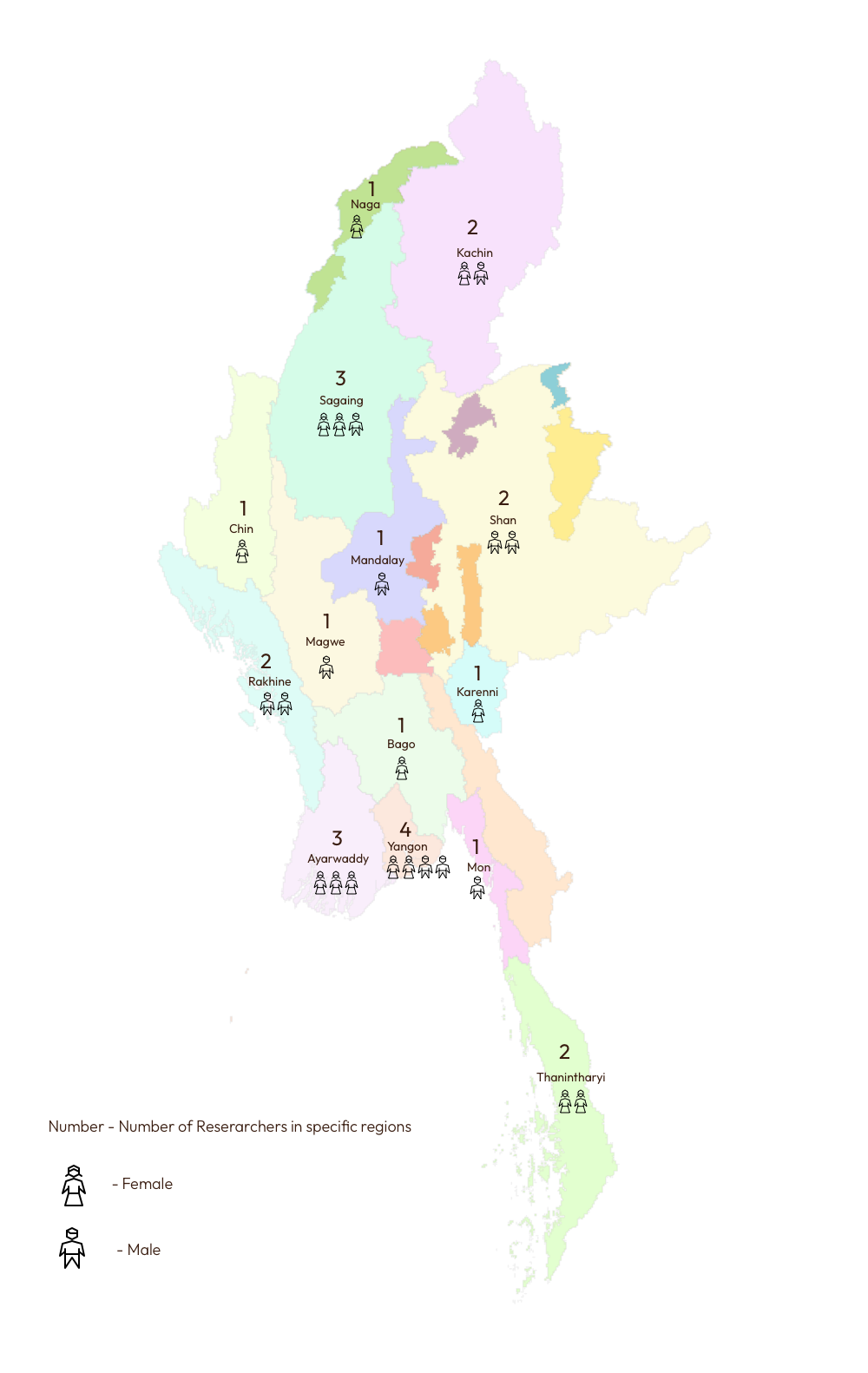
Nyan Corridor Community Research Map

Community ethnography/Community Research is an ethnographic approach grounded in the principles of inclusive and co-productive knowledge production. Within community ethnographic research, the boundaries between researcher, research process, and community are intentionally blurred; the community is not treated as a separate object of study, but as an active site of analysis. In conventional qualitative or ethnographic research conducted by external researchers, the studied community is often referred to as “they.” Community ethnography departs from this position: researchers describe the community using terms such as “we,” “some of us,” or “a few of us in the village/ward,” reflecting a mode of inquiry generated from within the community itself."

25
RESEARCHERS
14
REGIONS
RECENT ACTIVITIES
Humanitarian Observatory Myanmar

Launch of Humanitarian Observatory Myanmar

February 11, 2026

The Humanitarian Observatory Myanmar (HOM) will be officially launched on 11 February 2026 in Chiang Mai, Thailand. HOM is an independent, non-operational research initiative that documents and analyzes humanitarian systems in Myanmar, amplifying community-based evidence and the perspectives of affected populations. The launch event will bring together humanitarian practitioners, researchers, civil society, and policy actors to share HOM’s vision, highlight the importance of locally led humanitarian action, and foster informed dialogue on humanitarian governance in Myanmar and beyond.

Community Ethnography

Election Day – 2nd Phase

January 18, 2026

The second phase of the 2025 election revealed the military junta’s limited capacity to administer even basic electoral processes. Community researchers reported confusion over polling dates, missing or inaccessible polling stations, inaccurate voter lists, and low voter turnout across monitored townships. In several areas, people were informed about voting only one day before the election, while others were forced to travel to militarized locations to cast ballots. Election day was also marked by heightened military tension, including explosions, armed clashes, and increased arrests, reinforcing public perceptions that the election was a symbolic exercise carried out under instability and fear rather than a legitimate democratic process.

Community Ethnography

Voting in Terror

December 1, 2025

Based on community-based ethnographic research conducted across multiple regions of Myanmar, Voting in Terror documents how the military’s 2025 election has been experienced by ordinary people as a process shaped by fear, coercion, and uncertainty rather than choice. Community researchers observed widespread psychological pressure, including threats of conscription, surveillance by ward and village administrators, and intimidation of internally displaced persons (IDPs) and government employees. As the election approached, many people considered voting not out of political belief, but as a survival strategy to protect their families amid an environment of violence, repression, and deep insecurity.

REPORTS AND PUBLICATIONS